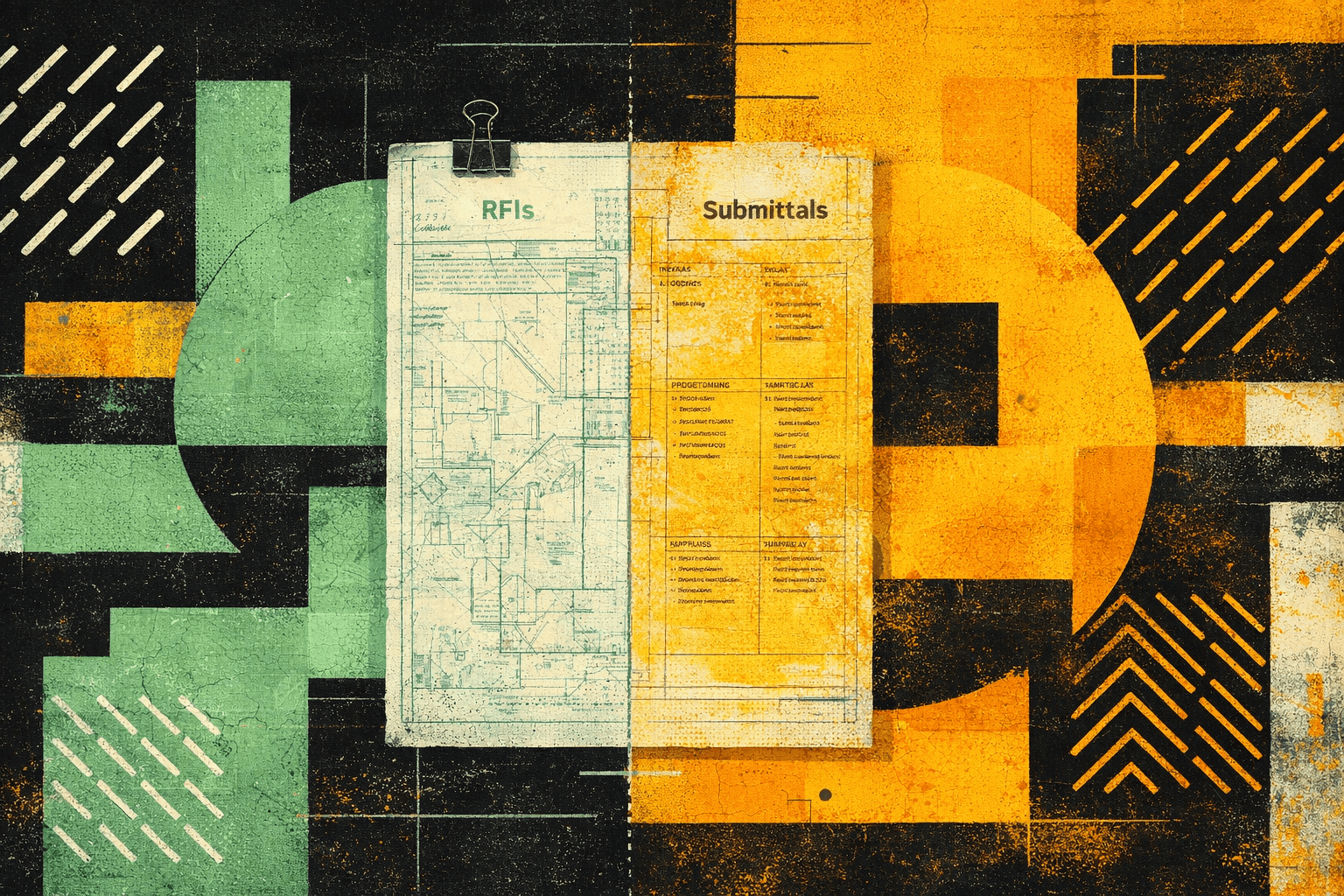
An RFI asks a question. A submittal presents proposed products or fabrication information for review. Confusing the two creates routing errors and contract exposure that project teams work hard to avoid.
The breakdown usually happens at the handoff between clarification and compliance, where misrouted items stall review and increase claims exposure. RFIs and submittals move through different routing paths, sit with different response owners, and produce different contract records, so sending one down the other's track corrupts the project record from the start.
This guide walks through the contract basis that separates RFIs from submittals, the routing and response rules that govern each, concrete examples of how they show up on a typical project, and where confusion between them creates schedule and claims exposure.
The Core Distinction is Purpose Under the Contract
An RFI seeks clarification of what the contract documents require. A submittal seeks confirmation that what the contractor proposes to furnish conforms to those requirements.
RFIs Clarify Ambiguity
Every RFI must reference the specific drawing, specification, or prior submittal that the requesting party already reviewed. The AIA G716 form, an AIA standard RFI form, makes this explicit. The form's boundary language is clear: "Neither the request nor the response received provides authorization for work that increases the cost or time of the project." An RFI is a question, and its answer becomes part of the permanent project record.
Submittals Confirm Compliance
Submittals prove that what the contractor intends to furnish matches what the contract requires. Under AIA A201-2017 §3.12, they include shop drawings, product data, and samples. Shop drawings, defined under §3.12.1, are "drawings, diagrams, schedules, and other data specially prepared for the Work by the Contractor or a Subcontractor, Sub-subcontractor, manufacturer, supplier, or distributor to illustrate some portion of the Work."
If your spec calls for "stainless steel fasteners" without specifying grade, you submit an RFI asking whether 304 or 316 is required. After the architect responds with 316, you submit product data confirming your proposed fastener meets 316 grade requirements. The RFI clarifies. The submittal confirms compliance.
RFI and Submittal Routing and Response (Side-by-Side Comparison)
Routing and response rules differ between RFIs and submittals. Project teams lose time at this handoff.
Routing Paths
RFIs often follow a relatively simple path. The contractor transmits to the architect or CM, if present, the architect routes to relevant consultants for discipline-specific questions, then issues a written response back to the contractor. On some CM-managed projects, the CM pre-screens RFIs with authority to reject frivolous or incomplete questions.
Submittals typically follow a more structured sequence. The contractor must review, stamp, and sign each submittal before transmission. Subcontractors cannot route directly to the design team. In a typical AIA-style workflow, the architect receives the package, routes it to discipline consultants, and returns it to the contractor. Under AIA A201 §3.12.7, the contractor "shall perform no portion of the Work" requiring submittal review "until the respective submittal has been approved by the Architect." Installation before approval can trigger delay and rework.
Response Time Windows
RFI response windows are contract-governed. For example, in this AIA contract, they set a response deadline, with a longer period only if reasonably requested and agreed to at the time of submittal. A shorter working-day review period is the practical benchmark for keeping RFIs from stalling the schedule. First replies can take about a week, with many extending longer.
Submittal review windows are governed by Division 01 33 00 of the project specifications, which defines the initial architect review period, the sequential consultant review period, and the resubmittal clock. The exact durations vary by project, but a few examples illustrate the typical range:
Institutional specifications for university projects allow around 21 calendar days for initial review of each submittal.
Federal and USACE practice, as outlined in this USACE contractor's guide, generally runs longer review windows than typical private commercial work. For example, contracts can specify up to 90 calendar days for approval of structural steel drawings or prefabricated metal building submittals.
Resubmittal timing typically resets the clock at the same initial window rather than running on an accelerated schedule.
These windows are generally not negotiable after the fact. State specifications explicitly state that no extension of contract time will be authorized for failure to transmit submittals early enough to permit processing.
Decision-Maker Authority
For RFIs, the architect is the primary respondent, routing discipline-specific questions to the engineer of record. The CM, when present, screens but does not respond to substantive design questions.
For submittals, the architect performs a coordinating review limited to general conformance with design intent, per AIA A201. Discipline consultants stamp items within their scope. The owner retains explicit review rights under A201 §3.10.2. Submittal stamp practice often uses stamps such as "No Exceptions Taken" rather than "Approved" to limit professional liability exposure. The word choice on that stamp is not cosmetic.
Concrete RFI vs Submittal Examples on a Typical Project
The contract and routing distinctions become easier to apply when you see how each item actually shows up in the field. The examples below illustrate the pattern where a design ambiguity routes as an RFI, while a compliance package routes as a submittal.
Design Conflicts Generate RFIs
Design conflicts between drawings are a common RFI trigger. A structural drawing shows a beam at one elevation while the architectural drawing shows a different ceiling height at the same location. That conflict generates an RFI referencing both drawing numbers, because the contractor cannot proceed until the design team clarifies which governs.
On an actual school project in Santa Barbara, a school project RFI shows RSH Construction submitted a scope clarification RFI on AIA G716. The RFI asked the design team to confirm which party was responsible for furnishing and programming HVAC controls. It referenced a specific mechanical drawing sheet. A straightforward question requiring a definitive response from the design team.
Compliance Packages Generate Submittals
Multi-component compliance packages are submittals by definition. A Division 23 HVAC controls package for a university project requires system architecture riser diagrams. The diagrams must show every controller connected to the IP layer and list the manufacturer name and model number for each component.
The package must be formatted in 11"x17" landscape and submitted electronically as PDF. These packages require the contractor's stamp and signature before transmittal, and the architect cannot accept them from any other source.
Where RFI and Submittal Confusion Breaks Projects
When teams route the wrong item through the wrong workflow, the damage shows up in schedule delays and cost exposure.
Schedule and Cost Exposure
Per FMI and PlanGrid's report, poor project data and miscommunication account for 48% of all rework across the built world, quantified at $31.3 billion annually in U.S. construction alone. When submittals route as RFIs, the response lacks an action stamp. When RFIs route as submittals, the question enters a compliance-package review queue.
The Claims Dimension
CMAA explicitly identifies the practice of using RFIs in place of submittals, including substitution requests and schedule submittals, as an abuse of the RFI workflow associated with future claims-building strategies. The foundational Navigant Construction Forum study found that 13.2% of all RFIs were unjustifiable, querying means and methods, requesting design changes, or raising questions already answered in contract documents. The same study reports that roughly one in four RFIs received no response, a significant indicator of construction disputes.
When a project engineer routes a substitution request as an RFI instead of a formal submittal under Division 01 25 00, the response lacks the architect's action stamp. The contractor proceeds without a documented approval path. That undocumented substitution can later become a change order dispute.
Datagrid's RFI Validator Agent would catch that miscategorization at the point of creation, flagging the substitution request for routing through Division 01 25 00 before it ever reaches the architect as an RFI.

Validation Moves Upstream, Before Routing
Catch a bad RFI or an incomplete submittal before it enters the formal workflow. Once the item is in the log, the team is already spending review time on avoidable admin work.
Datagrid's AI agents move validation upstream, running checks before RFIs enter the project log and before submittal packages reach the design team. Rather than catching incomplete or miscategorized submissions during review, the agents cross-check project files at the point of creation and execute the workflow steps a project engineer would otherwise run manually. The RFI Validator Agent validates submissions before they enter the log, and the Deep Dive Spec Submittal Agent compares submittals against specifications to identify compliance gaps and scope misalignment.
That operating model shifts attention toward review judgment.
What Project Teams Report
Faster review is the practical outcome project teams care about. Jacob Freitas, Product Executive at Level 10 Construction, said:
"With Datagrid we are able to review submittals far faster than before."
That testimonial points to lower reported review effort, which can let project teams focus on exception handling and design coordination.
Validate RFIs and Submittals Before They Route
Datagrid's AI agents validate submissions at the point of creation, before they consume design team hours. For project teams managing high-volume built world workflows, that means catching category errors and spec mismatches before they enter formal review. See how it works for your project workflows.