
Overview
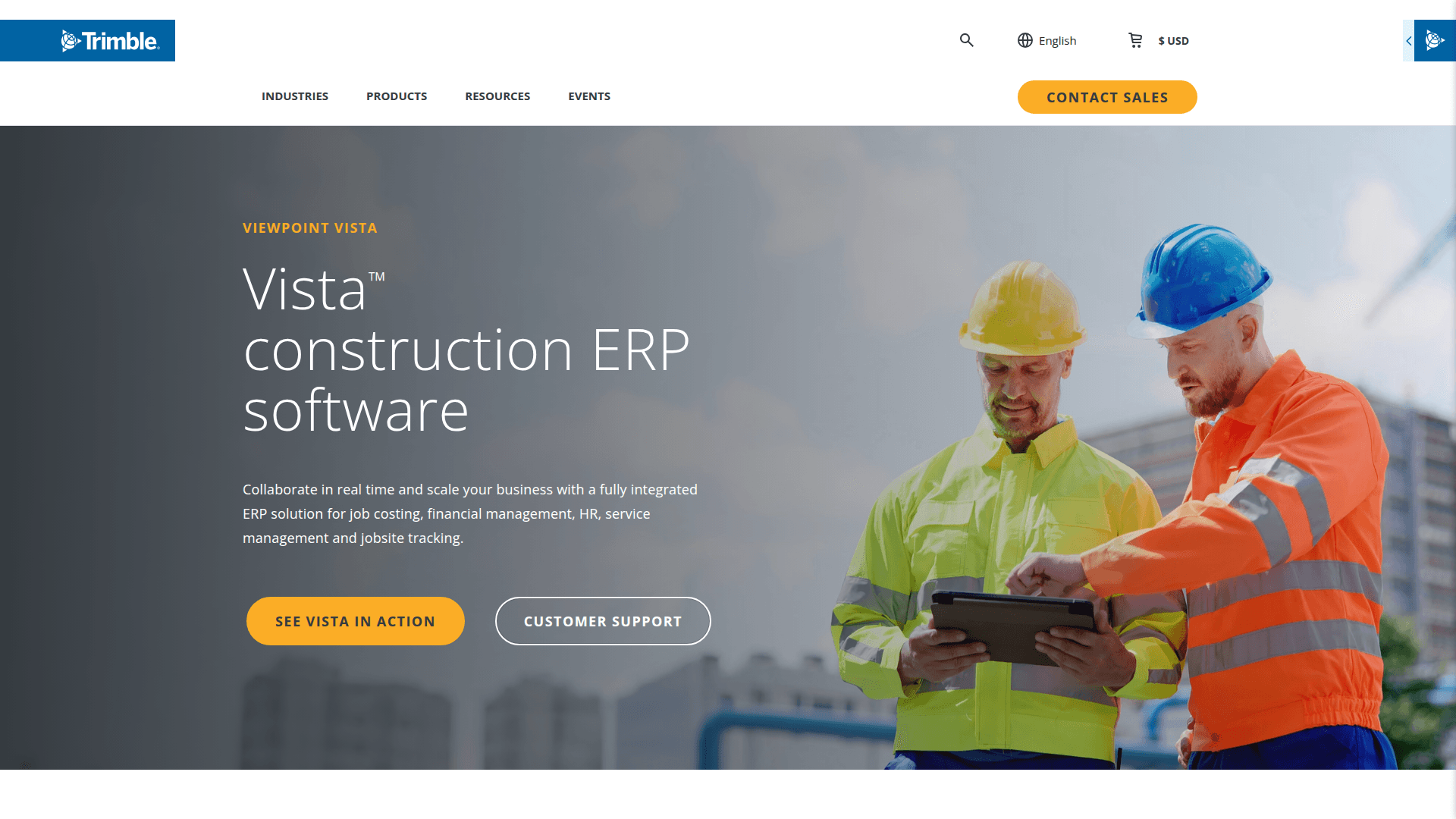
What is Viewpoint Vista: Viewpoint Vista is a construction ERP and accounting platform from Trimble. Trimble describes Vista as an integrated ERP for job costing, financial management, HR, service management, and jobsite tracking across modules including Accounts Payable, Job Cost, General Ledger, and Payroll.
How to integrate Viewpoint Vista with Datagrid
The integration syncs financial and project data between Vista and Datagrid using the Trimble App Xchange REST API. Setup starts with integration configuration and Vista authentication. Then Datagrid syncs the selected Vista data. Datagrid's agents read AP invoices, JC jobs, GL transactions, payroll entries, and subcontract records. They then write approved records back to Vista. The Trimble App Xchange REST API mirrors the folder structure of the Vista database across 18 modules.
Configure the Datagrid integration
Use the setup sequence below to connect a cloud-hosted Vista instance through App Xchange.
Confirm you run a Trimble Construction One cloud-hosted Vista instance. The Vista API overview covers Vista REST API eligibility.
Begin App Xchange onboarding. The App Xchange team installs the Xchange Agent on your Vista server.
Set up a SQL user with credentials for Vista database access.
Select the modules and endpoints you need. Front-load this decision, since Trimble App Xchange may require a change order fee for endpoint changes after onboarding.
Receive your API key and subscriber code on completion.
Enter the API key and subscriber code in your Datagrid integration settings.
Test against the available test environment before connecting to production.
Authenticate with Vista
The Vista API uses an API key plus a subscriber code, both issued during onboarding. For third-party access like Datagrid, Trimble issues a specific API key with limited permissions scoped to the areas of Vista you choose.
Sync Vista data
The Vista API is bidirectional at the API level. Datagrid-to-Vista writes depend on each Vista endpoint's POST, PUT, or DELETE support, as defined in each module's OpenAPI spec. Near-real-time sync runs on scheduled polling. A default 12-month data window applies to AP/Invoices, AR/Transaction Lines, DM/Attachments, and GL/Transactions. It also applies to JC/Cost Details, JC/Cost Detail Periods, MS/Tickets, and PO/PO Headers. PR/Time Entries and SL/Subcontracts use the same default window. Request a static backfill date during onboarding for older data. Trimble App Xchange historical access is subject to Trimble platform performance limits.
Once the integration is scoped and live, Datagrid agents keep Vista finance workflows moving without copy-paste between field systems and accounting review.
Why use Viewpoint Vista with Datagrid
Connect Vista to Datagrid when finance work depends on the same project records moving cleanly between the field, accounting, payroll, and reporting. Here's why you need to use Viewpoint Vista with Datagrid:
Automated invoice coding: Agents extract invoice numbers, vendor details, line items, amounts, job numbers, and cost codes from PDFs, then post AP records to Vista without manual entry.
Job-cost accuracy across projects: Agents assign Vista cost codes and job numbers, run 2- and 3-way PO matching, and track retainage across multiple jobs.
Bidirectional financial sync: The App Xchange REST API reads Vista data and writes validated records back, so AP, JC, GL, and payroll stay current without copy-paste.
Forecasting on current data: Agents sync Vista financial modules on a scheduled basis to feed WIP schedules, over/under billing analysis, and cost-overrun detection models.
Field-to-ERP reconciliation: Agents transform field reports and change orders into Vista's schema and post them. This closes the gap between jobsite and accounting.
Compliance checks across modules: Consistent synchronization keeps financial reporting aligned across modules and closes compliance gaps for finance teams.
What you can build with Viewpoint Vista Datagrid integration
Datagrid gives finance and operations teams a way to turn Vista records into executable workflows. Some common Vista and Datagrid workflows include the following:
Automated AP invoice pipeline: Build an agent that ingests vendor invoices by email or scan. It extracts line-item detail and auto-assigns Vista cost codes and job numbers.
Job cost and WIP reporting pipeline: Build a pipeline that extracts JC, GL, AP, and PR data on a schedule.
Workforce data sync: Build an agent that pulls timesheet and labor data from field apps. It maps that data to Vista's PR and HR schema, then writes hours to payroll.
Financial anomaly detection: Build an agent that syncs AP, AR, GL, and Job Cost data on a recurring schedule.
Resources and documentation
Vista API concepts explains how App Xchange stores and acts on Vista data.
Vista setup guide documents onboarding steps and authentication setup.
Vista API overview covers Vista REST API eligibility, data access, and endpoint details.
Frequently asked questions
Is the Vista API available to all Vista customers?
No. Use the setup checklist to confirm deployment eligibility. On-premise deployments cannot use the REST API directly. See the Vista API overview.
How does Datagrid authenticate with Vista?
Authentication uses an API key and a subscriber code, both issued during App Xchange onboarding. For third-party access, Trimble issues a specific API key with limited permissions scoped to the Vista areas you choose. Details are in the Vista setup guide.
Can agents read historical data beyond 12 months?
Yes, if you request a static backfill date during onboarding. Trimble App Xchange historical access is subject to Trimble platform performance limits. See the data limits in the Vista API overview.
Can I add more modules after the initial setup?
Yes. Endpoints can be changed at a later date, but Trimble App Xchange changes may require a change order fee. Select your modules carefully during onboarding. See the Vista API overview for endpoint selection details.
Similar integrations
Procore: Sync Procore project and RFI data with Vista to align job costing, budgets, and invoice workflows for accurate project financials.
PlanGrid: Connect PlanGrid field documents and markups with Datagrid to route change orders and keep project records aligned.
BuildingConnected: Sync BuildingConnected bid and subcontractor data with Datagrid for preconstruction and procurement workflows.
Textura: Connect Textura payment application data with Datagrid to ensure accurate subcontractor payments and lien waiver tracking.
Fieldwire: Integrate Fieldwire task and field data with Datagrid agents for jobsite-to-accounting coordination.