All Posts
Construction - AI-Powered Project & Workflow Automation
Manual vs AI-Automated Daily Construction Reports

.jpeg)
This article was last updated on November 8, 2025
Your project manager discovers a costly subcontractor error that proper daily reporting would have caught weeks ago. While thin project margins vanish with each passing day, the team scrambles to recover. All because documentation gaps created blind spots that allowed small issues to grow into expensive problems.
Construction managers spend their limited hours processing paperwork instead of preventing these costly delays. The documentation burden steals focus from critical field operations. This creates a productivity crisis that undermines project timelines and team effectiveness in an industry where delays directly impact profitability.
AI agents are automating construction reporting by handling data collection and processing automatically. Datagrid's system processes field information and generates daily reports without manual compilation. This allows you to break free from documentation overload and reclaim your valuable time for what truly drives project success.
What Daily Construction Reports Must Document (And Why Manual Processes Fail)
Daily construction reports document every site activity, creating an audit trail that protects your project and budget. Teams that maintain detailed records reduce dispute costs and identify delays earlier than projects relying on weekly summaries.
Here's what effective reporting delivers:
Progress verification: Track actual completion against schedules, identifying delays before they cascade into extended setbacks
Cost control: Document labor hours and material usage, catching budget overruns early when they're manageable problems
Risk prevention: Create timestamped records that resolve disputes with documented evidence, reducing legal costs
Effective resource management is another key benefit, as these reports document labor hours, equipment usage, and material deliveries. This documentation helps you allocate resources efficiently and control costs by monitoring actual versus budgeted resources.
Daily reports also support quality control by recording inspections and results. They simultaneously ensure safety compliance through documentation of safety meetings, trainings, and any incidents that occur.
From a legal perspective, these reports provide invaluable risk mitigation by creating detailed records that can resolve disputes or claims. They improve stakeholder communication by keeping all parties informed and creating transparency.
Additionally, they establish a historical record for future reference and support financial management. They accomplish this by documenting daily site activities and providing data that can be used to justify change orders.
This documentation becomes especially valuable when issues surface months after work completion.
To maximize these benefits, your daily reports should include specific information such as weather conditions, worker counts by trade, and equipment and materials used. They should also document completed work activities, delays or incidents, site visitors, and photographic documentation of progress. All of these elements significantly improve project outcomes.
How AI Agents Generate Daily Reports
Project managers spend hours daily gathering field notes from superintendents, extracting data from photos, and manually entering information into project systems. This documentation lag means yesterday's issues don't surface until tomorrow's reports. AI agents eliminate this bottleneck by processing field data automatically as it's captured.
AI Agent Capabilities for Construction Reporting
AI agents are autonomous software programs that perceive their environment, make decisions, and take actions to achieve specific goals within the construction industry. Unlike traditional software, these intelligent systems operate with varying degrees of independence, reducing the need for constant human oversight while handling complex data processing tasks.
In construction reporting, AI agents serve as automated assistants that change how project data is collected, processed, and presented. Their primary function is to automate repetitive and time-consuming reporting tasks that would otherwise require significant manual effort from project managers and team members.
The key characteristics that make AI agents valuable include:
Autonomy: They operate independently, gathering and processing information without continuous human guidance.
Reactivity: They respond intelligently to changes in project conditions and new data inputs.
Proactivity: They take initiative to collect relevant information before being explicitly asked.
Learning capability: They improve performance over time through experience with project data.
AI agents handle construction management's data-intensive aspects by automating data collection from multiple sources. They also standardize information formats and generate consistent reports. This automation significantly reduces the administrative burden on construction teams while improving the accuracy and timeliness of project reporting.
These agents are particularly effective at processing large volumes of construction project data that would be overwhelming for human analysts. They can quickly identify patterns, detect anomalies, and generate insights that help project managers make more informed decisions.
Data Collection Through Multiple Channels
The automation process begins with collecting data through multiple channels:
- Mobile app entry by field workers using construction management platforms
- Automated data collection from IoT sensors and devices that monitor site conditions
- Scanning of paper documents using OCR technology for digitizing handwritten notes
- Direct integration with existing project management software
During this phase, various data types are collected: labor hours, equipment usage, materials, weather conditions, safety incidents, progress photos, and field notes.
Processing Unstructured Field Data
Once data is collected from various sources, AI-powered systems process it through:
- Natural Language Processing (NLP) to interpret text from notes and comments
- Computer vision algorithms to analyze progress photos and videos
- Machine learning models to identify patterns and flag anomalies
This AI-based data extraction is particularly powerful as it can handle unstructured information and convert it into standardized data points. The system also performs automated validation by cross-referencing with project schedules and budgets, flagging inconsistencies for human review.

Automated Report Generation and Distribution
After the collected data is processed and validated, the system automatically generates reports by:
- Populating customizable report templates that match your company's format
- Creating relevant charts and graphs from numerical data
- Using AI to generate narrative summaries of key events and progress
With reports now automatically generated, the system handles distribution through:
- Automated email delivery to stakeholders
- Direct integration with project management platforms like Procore
- Secure cloud storage for easy access and searchability
Here's how AI agents handle daily reporting for a construction site:
Field supervisors upload progress photos throughout the day. AI agents extract completion percentages, identify safety issues, and cross-reference against schedules. The system processes time cards, equipment logs, and material deliveries. Stakeholders receive reports showing actual vs planned progress, safety incidents, and resource utilization.
Total human time required: Minutes of photo uploads vs hours of manual compilation.
Key Benefits and Quality Control
AI agents generate reports in minutes instead of hours, automating the entire workflow from data gathering to formatting and distribution. This frees your team to focus on strategic thinking and problem-solving rather than manual data entry. The systems scale to handle large report volumes without requiring additional resources, and can assist in automating budgeting and cost predictions.
AI eliminates common human errors from fatigue, boredom, and distraction while maintaining consistent precision regardless of workload. Modern AI reporting systems detect anomalies, inconsistencies, and outliers in your data, validating information against predefined rules and flagging issues in real-time for human review. While AI can help reduce subjective influences in reporting, it is not inherently free of bias. AI systems can inherit or amplify biases present in their training data, requiring careful oversight and transparency.
AI agents provide robust compliance capabilities that improve project oversight:
Safety and Specification Monitoring: Automated detection of safety violations through image recognition of PPE usage and unsafe conditions. Real-time alerts when safety thresholds are exceeded. Continuous monitoring of work against project specifications and building codes with automated flagging of deviations.
Progress Verification: Photo analysis that quantifies completion percentages against schedules. Comparison of actual installation against BIM models to detect deviations. Weather condition correlation with productivity metrics to validate delay claims.
By leveraging AI agents for construction reporting, teams can process more data than humanly possible while maintaining higher accuracy levels. This frees up valuable human resources for more strategic tasks that require judgment and creativity. AI can also automate meeting notes and improve sales engagement strategies for better client relationships.
Connecting Your Existing Construction Software
Modern AI agents connect with multiple data sources and platforms, creating a unified ecosystem for project oversight. Datagrid's AI agents connect to over 100 data sources through unified APIs, eliminating the need to build custom integrations for each workflow. The platform processes data from field apps, project management systems, and document repositories simultaneously, creating a single source of truth for daily reporting.
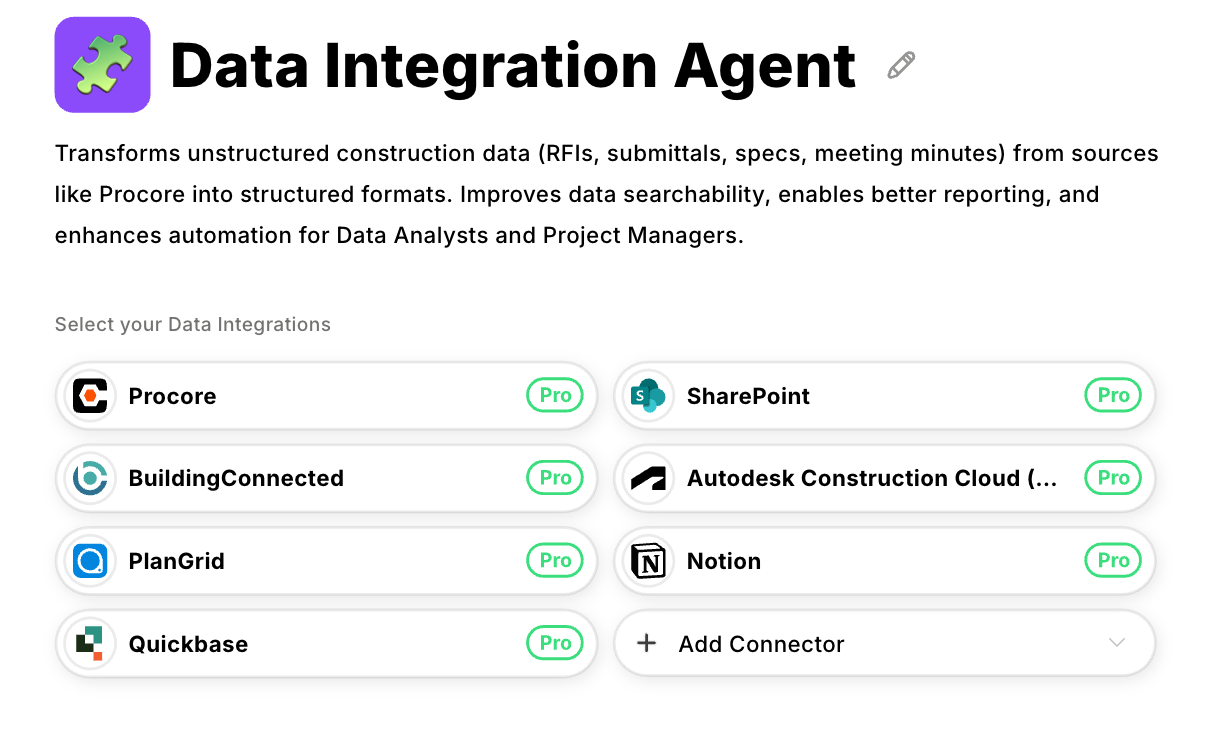
For construction companies managing multiple active sites simultaneously, these integration capabilities are particularly valuable. AI agents can collect, process, and standardize reporting from multiple locations without the typical manual compilation time. This allows leadership to focus on addressing issues rather than gathering information.
When one site experiences a material delay that might impact another location's schedule, AI agents can automatically alert both teams. This enables proactive resource reallocation and eliminates typical communication lag that occurs with manual reporting systems.
Adapting to Your Project Workflows
AI project management agents offer flexibility in adapting to specific project demands:
- AI-powered productivity recommendations tailored to your workflow
- Natural language processing that allows team members to query project data directly
- Predictive analytics to identify potential project risks before they impact deadlines
These integrated AI solutions deliver improved efficiency in project execution, better team collaboration, real-time insights for decision-making, and automated task management. By connecting your essential project tools through AI integration, you create a more cohesive and responsive project management environment.
Preventing Regulatory Violations with AI
Construction teams track compliance across dozens of systems: safety logs, EPA emission reports, prevailing wage documentation, building permits, and state-specific mandates scattered throughout disconnected databases. When compliance officers arrive, teams scramble through spreadsheets and paper files searching for documentation that proves they followed the rules.
AI agents eliminate this reactive approach by continuously processing regulatory information, formatting reports automatically, and flagging violations before they occur:
- Real-time compliance monitoring prevents documentation gaps. Construction compliance now requires continuous digital documentation across safety logs, EPA emission monitoring, prevailing wage reports, building permits, and state-specific requirements that change quarterly. Manual logs and monthly audits can't keep pace with regulatory expectations.
- Automated prevailing wage calculations eliminate payroll errors. Construction management platforms embed wage determinations directly into timesheets, calculate rates automatically, and flag anomalies before payroll runs. Geofenced tracking locks hours to specific projects while AI flagging catches classification errors before payroll processing.
- Multi-state regulatory templates adapt automatically to jurisdiction requirements. Centralized platforms store jurisdiction-specific templates and push automatic updates when rules change. Regulatory dashboards show every project's status instantly, highlighting missing documentation before inspections.
- AI agents predict violations before they occur. While traditional systems organize documents faster, AI agents actively prevent regulatory breaches by processing schedules, photos, weather data, and sensor readings simultaneously. Natural-language models read new regulations, compare them against current workflows, and highlight gaps before inspectors arrive.
AI Adoption Challenges and Solutions
Get Started with Automated Construction Reporting
Datagrid's AI agents handle the daily reporting workflow that currently consumes hours of your project team's time:
- Automated data collection from 100+ sources: Connect your existing construction software, field apps, and IoT devices without building custom integrations. Datagrid's unified APIs pull data automatically from project management platforms, time tracking systems, and document repositories.
- Real-time report generation and distribution: AI agents process field photos, extract completion data, cross-reference schedules, and generate stakeholder-ready reports in minutes instead of hours. Reports are automatically formatted and distributed to your team without manual compilation.
- Continuous compliance monitoring: Track safety logs, permit status, prevailing wage documentation, and regulatory requirements across multiple jurisdictions. The platform flags potential violations before inspections and maintains audit-ready documentation automatically.
- Multi-site project coordination: Standardize reporting across all active construction sites without additional manual effort. When delays or issues arise at one location, AI agents automatically alert impacted teams and enable proactive resource reallocation.
- Quality control and error prevention: AI validates data against project schedules and budgets, detects inconsistencies at entry, and flags anomalies for human review before they impact project timelines.
Start automating your daily construction reports with Datagrid to eliminate hours of manual compilation and gain real-time visibility across all your projects.
Related posts